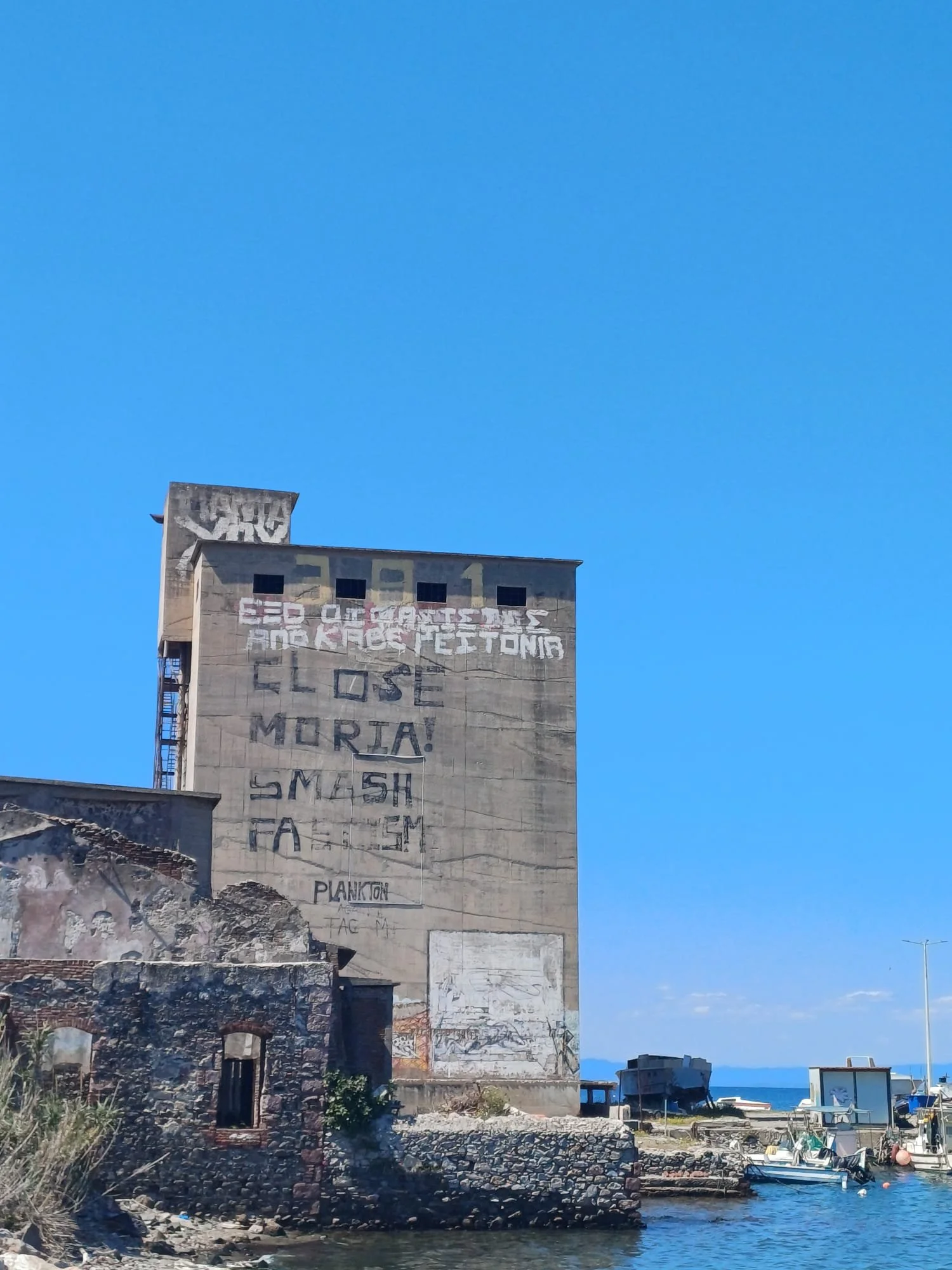
Lesvos, the birthplace of Sappho, sits just seven miles from the shores of Turkey. At first glance it appears calmer than most Greek islands. Ten minutes from the capital Mytilene, sits the Mavrovouni Closed Controlled Access Centre (CCAC), a place where around 2,700 people wait. Asylum seekers, most having crossed from nearby Turkey, are held here while their claims are processed, a system that can take months or longer. The camp, built on a former military site, is part of the European Union’s external border regime, designed to register, contain and manage arrivals at one of Europe’s closest entry points.
I spoke with Maddie, a British volunteer on the island, about her experience working in the camp, including what she feels the headlines miss (or, perhaps more aptly, misrepresent).
What were your first impressions of the island and the camp?
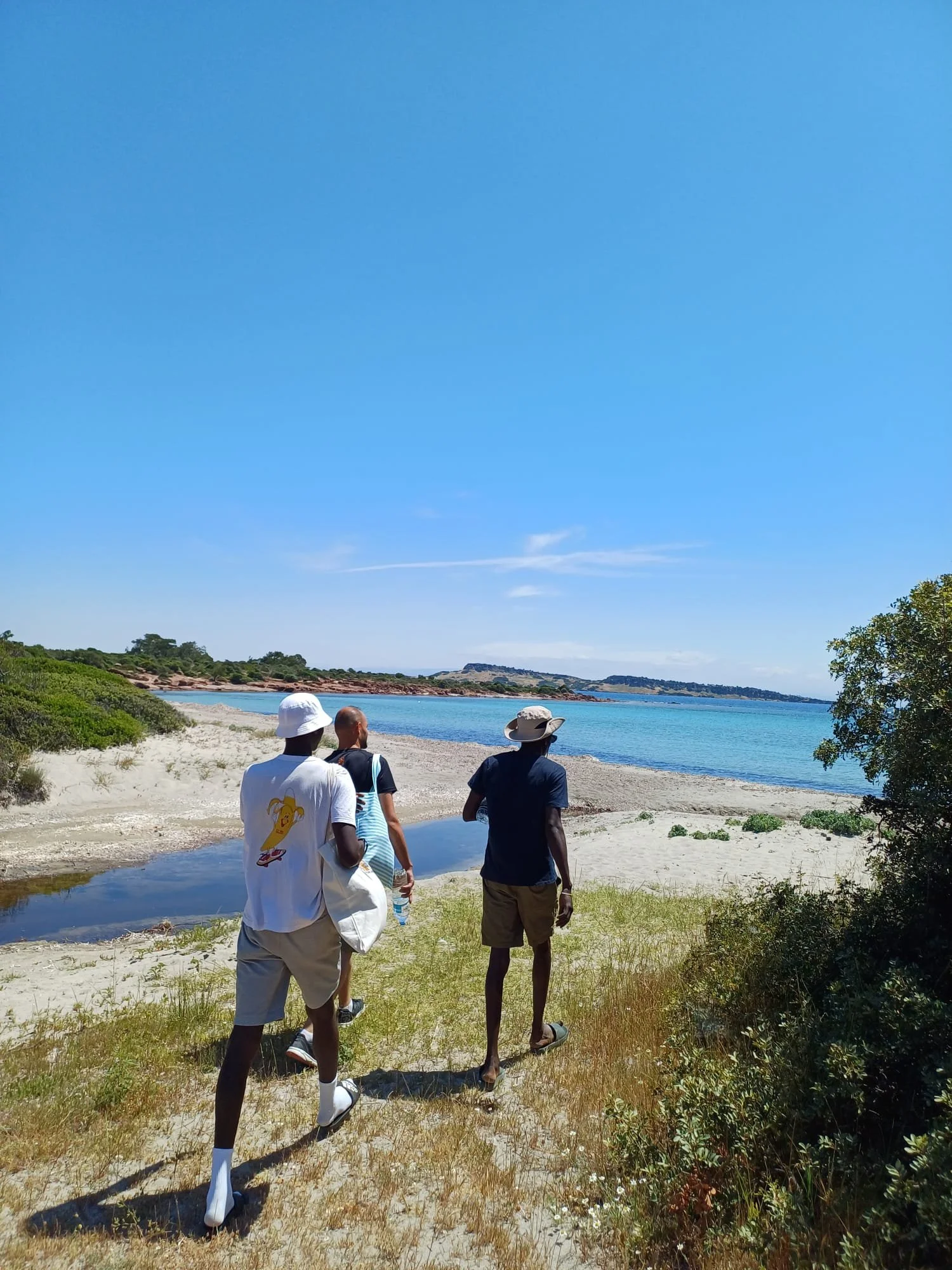
It’s so green, that’s what surprised me the most. I’m from the English countryside and ever-fond of our landscapes that see fields and wildflowers meet the sea. It’s botanically dense and lush, I think it has over eleven million olive trees. I’ve also never experienced a sea that salty. You come out and your skin is crusted in a white layer that then dries in the sun. With regards to the camp itself, I didn’t know what to expect. There’s so little public information on specific camps, which unfortunately can range drastically in conditions. Lesvos CCAC sits along the main coastal road, so it’s very visible to locals, though there are strict security measures for entry and exit. There’s a bus that connects people to Mytilene, so there is movement between the camp and the town.
Can you describe a typical day at the camp? What kind of work were you doing?
Mostly I helped with the women's space, the vocational training programme, and teaching English to unaccompanied minors. The NGO offered music and art classes, computer and sports sessions, even a barber and tailoring services. Individually they seem minor, but together they compound to build a form of routine, which is one of the few stabilising forces in a place defined by waiting. Without occupation, minds can be left to ruminate on negative thoughts. Activities like these helped residents build routine and structure in an otherwise turbulent situation. They also helped people develop useful skills for their future lives.
Logistically, who keeps the camp running behind the scenes?
It’s a layered system rather than a single operator. Inside the camp, the core infrastructure is provided by the UNHCR, large tented structures with more permanent facilities, including medical services, sports areas and a mosque. Around that, different NGOs operate out of container units, each running their own programmes and activities.
The Greek authorities are closely involved, and there is a visible security presence, managed by a private contractor alongside policing on site. In recent years, tighter regulations on NGOs working in migration and asylum have made the operating environment more restrictive, particularly for international organisations, adding another layer of control to how the camp functions day to day.
What do you wish more people understood about the reality of refugee life in Lesvos?
Coming from a Western context, and a comparatively comfortable life, there’s an assumption shaped by media coverage that the camp is defined by constant visible trauma, that distress is immediately legible and present in every interaction.
In the first couple of weeks, I found myself reacting emotionally to everything, reading heaviness into situations where it wasn’t necessarily being expressed. In many cases, that was my projection rather than what people were actually showing. Most of the time, people did not want to talk about what had happened to them. They were simply living their lives within the constraints of where they were.
What stood out more was a kind of steady optimism, or at least forward motion. That can come from survival, but also from the way communities form under pressure, people are highly aware of each other, and there is a strong sense of mutual support and motivation. It challenges the outdated model of charity more generally, where people are framed as passive recipients of help. That idea doesn’t really hold here, and increasingly it’s not the model many organisations are working with either.
Did you see any policy in action that worked, even in small ways?
In Greece, refugees are allowed to work while their asylum claims are being processed, they don’t have to wait for a decision before entering the labour market. In the UK, that can take up to a year, with limited financial support in the meantime. That difference changes how people integrate within local communities. Some of the hostility you hear locally often comes from the perception that people are receiving support without contributing economically, even when that is not an accurate reflection of their circumstances. Employment access shifts that dynamic, even if imperfectly.
Was there a particular encounter or moment that’s stayed with you?
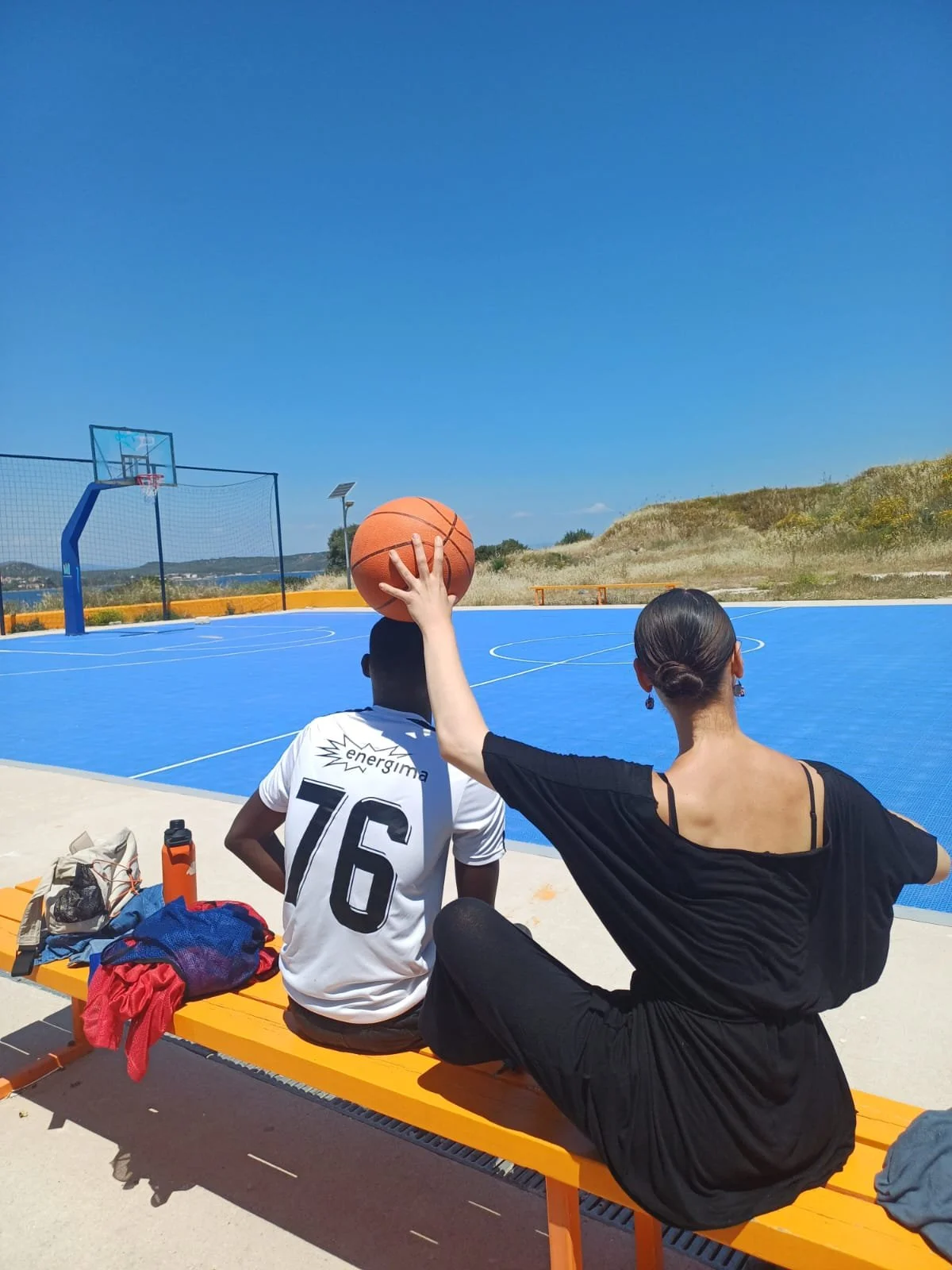
We spent a lot of time doing sports with the children. The NGO I was with had built a new pitch up on a hill above the main camp. One afternoon I was there with a group of kids when a small group of girls took my hand and led me further up into the hills, to a stretch of grass looking out over the sea. It was completely quiet and they were picking flowers as we walked. They didn’t speak any English, but just wanted me to come and appreciate the view. Given what the environment is like day to day for children there, it was a welcome calm moment. We sat and looked out across the water for a long time.
Did your time working in the camp shift your perspective on migration?
I think my perspective became more focused on safe routes, and the reality that people will move regardless of how dangerous the journey is. That was one of the clearest things from speaking to people there. The route to Greece is already hazardous, and for many it is only the first step. Some are trying to reach the UK knowing the risks involved, but doing so because there are few other options that feel viable. At the same time, you can’t ignore the reaction from local communities, or reduce it to a single narrative. There is a need to understand where that backlash comes from, often fear, economic pressure, and political messaging, even when the beliefs themselves are difficult to agree with. It requires more than dismissal. Unfortunately, rarely are these realities addressed together. Any workable approach has to involve both, not treating them as separate problems but as part of the same system.
If someone reading this felt compelled to engage, what would you say is the most useful thing they can do?
A lot of NGOs don’t necessarily need visiting volunteers in the way people assume. In many cases, the more effective model is strengthening the people already embedded in those systems, particularly community volunteers who are locally based, speak the language, and are far better placed to support others in a consistent way. Volunteering itself is also a privilege, it is not equally accessible, and that shapes who gets to participate and who does not.
There is value in it, especially in terms of perspective, but I would often suggest starting closer to home. There are many people seeking asylum in the UK, and there is real impact in being part of that support as a local community member, in ways that are sustained rather than episodic.
More broadly, the aid landscape itself is under pressure. It’s now been over a year since USAID saw cuts to 80% of its foreign aid projects, which historically channelled a large proportion of its budget through NGOs. Combined with reductions from other donor governments, this has contributed to a measurable contraction in global aid capacity, alongside staffing losses and a loss of institutional knowledge that is difficult to rebuild quickly.
In that context, I think organisations are placing greater emphasis on making what already exists more resilient, more local, and less dependent on volatile external funding.
“The comparison is almost ecological, whether systems are being imported and maintained from the outside, or whether they are able to grow and sustain themselves where they are rooted.”